

This summer, high school students from around the nation participated in hands-on simulations that demonstrated how economic theories play out in real situations through TFAS’s High School division, the Foundation for Teaching Economics (FTE). Economics instructors and participants traveled to 15 university campuses nationwide to deliver the Economics for Leaders program.

Through the Economics for Leaders program, economics instructors lead students through challenging economic issues and help them build strong critical thinking skills. Students also examine current national and international topics, encouraging thoughtful discussions and a deeper understanding of how economic principles apply to the world around them.
Program sites included the University of Virginia, Yale University, Cornell University, UCLA, Duke University and more.
Nick Martin, a program coordinator from California, said the program gives students space to grow and explore what they are passionate about.
“It’s a really important opportunity for not only their own personal growth, but also with economics as their passion,” Martin said. “They don’t get just a classroom experience where they get to learn more about what they want to do with their life, but they also get to meet new people and find themselves throughout the week.”
Using the Economic Way of Thinking
High school sophomores and juniors spend time exploring economic principles and how they apply to real-world scenarios. Topics include economic growth and scarcity, opportunity cost, open markets, markets in action, labor markets, incentives and the role of institutions, property rights, government, money and inflation and the international market.
Economics instructors incorporate interactive activities into lessons to engage students and provide a comprehensive view of economics, developing students’ understanding of how economics topics apply to their own lives.
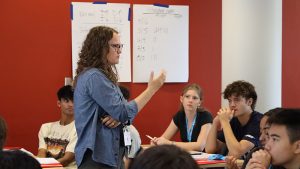
Caroline, a high school junior who attended the Economics for Leaders program at the University of Virginia, emphasized that the program gave language to a way of thinking already familiar to daily life.
“FTE taught me that economics is like decision-making,” Caroline said. “I always weigh my options. The marginal benefit is greater than the marginal cost and this week taught me that in every decision I make I’m applying economics.”
Activities such as the “Fish Game” exemplify how property rights and policies deeply impact the marketplace. They display what happens when a market has too little or too much legislation. Through this activity, students simulated a self-interest and incentive-driven marketplace, setting up the foundation of the day’s lesson for instructors to build upon.
By incorporating examples of current events and building a foundation with activities, instructors equip students to understand economic topics more thoroughly.
Building Tomorrow’s Leaders
Economics for Leaders also helps students become thoughtful, effective leaders. Through individual and team exercises, participants discover their leadership strengths, learn to collaborate with their peers and apply economic thinking to responsible decision-making.
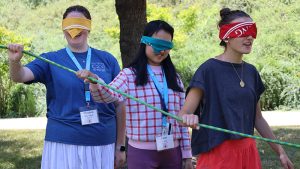
In addition to classroom economics lectures and lessons, leadership development activities challenge students to navigate situations they may encounter in their personal lives and future careers. After each exercise, students examine their actions and emotions and reflect on what the experience taught them.
Students leave the program feeling empowered to reflect on their accomplishments while staying motivated to pursue future goals. Many students report that the program experience prepared them to navigate high school and college, building confidence in decision-making and leading themselves, and others, through difficult challenges.
Maddie Fratz, a student from New Jersey, reflected on how the activities helped grow her understanding of economics and herself.
“FTE gives us challenges and obstacles that we must overcome to teach us that there is not only one way to overcome an obstacle or challenge, but that there are so many different ways to overcome things,” Fratz said. “I’ve learned how to approach finding out what works for you and how you can overcome those obstacles.”
Connecting Future Leaders for Years to Come
Toward the end of the program, students come together to share their thoughts and perspectives with one another, forming lasting bonds.

Ella Green, a high schooler attending Economics for Leaders at the University of Virginia, reflected on her insights after the program, sharing how the program gave her the opportunity to connect with peers and build new friendships.
“Coming into a place where you don’t know anyone is scary,” Green said, “But now I couldn’t imagine not having done this.”
Through these activities, students gain a deeper understanding of themselves and their peers. The lessons they gain through Economics for Leaders extend far beyond the summer, shaping how they support others and will become leaders in college and their future careers.
For more than half a century, TFAS has empowered students and educators nationwide, shaping young leaders and classrooms alike. In addition to the Economics for Leaders program, over the course of this summer, FTE also hosted Entrepreneurship in the Global Economy, Environment & the Economy and a new Civics & Economics in Action program for high school students on more than 30 college campuses this summer.
With nearly 32,000 alumni of high school and teacher programs, TFAS is building a nationwide network of students and educators prepared to advance economic understanding and responsible leadership.
Generous donor support makes this lasting impact possible, equipping participants to carry these lessons into classrooms, campuses, careers and communities nationwide.
Make a gift today at TFAS.org/support to prepare the next generation of thoughtful, principled leaders.