
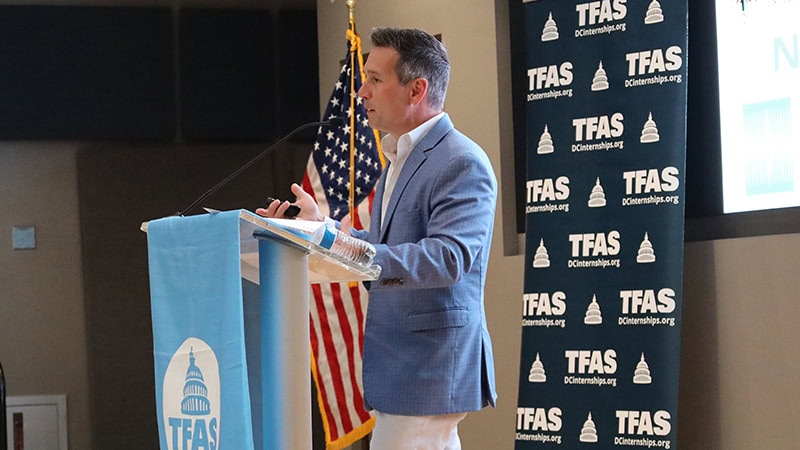
On Tuesday, June 9, The Fund for American Studies (TFAS) hosted the 2026 Lev Dobriansky Lecture on Political Economy. This year’s keynote speaker was Scott Lincicome, Cato Institute’s vice president of general economics and of the Herbert A. Stiefel Center for Trade Policy Studies.

Dr. Anne Bradley, TFAS’s vice president of academic affairs, introduced Lincicome to the audience. She highlighted his two decades of practice in international trade law, as well as his research and commentary experiences in areas including economic incentives, supply chains and economic dynamism.
Lincicome delivered his expert lecture titled “U.S. Trade Politics: Just as Adam Smith Predicted?” in commemoration of the 250th anniversaries of both America’s Founding and Adam Smith’s seminal book on political economy, “The Wealth of Nations.”
UNDERSTANDING U.S. TRADE POLITICS
In his lecture, Lincicome analyzed America’s economic history and its current state of trade policy through the lens of Smith’s enduring political ideas about free markets.
His remarks focused on three specific concepts:
- Organized industry lobbying – Government policy should not facilitate private business assemblies because of industry’s tendency to grow at the expense of consumers. However, American legal decisions have enabled America’s modern trade lobbying complex to grow and deeply embed itself into the government.
- Protectionist policymaking – Consumers should carefully examine new legislation because of the tendency of elected officials to create policy that benefits industry. However, consumers have little incentive to learn about new legislation, and protectionist policymaking is becoming increasingly opaque.
- Structural barriers to achieving free trade – Structural obstacles will ensure that free trade can never be fully realized. He explained the difficulty in repealing protectionist legislation, as exemplified by several American policies.
A WAY FORWARD
Lincicome concluded his lecture with a positive outlook on future trade reforms and hope for the next generation of trade policy leaders.

“In his political writings, he’s shown us a bit of a roadmap forward,” Lincicome said, referring to Adam Smith. “It’s our task to follow that roadmap.”
The lecture evoked thoughtful reflection among the students, many of whom posited questions to Lincicome on the writings of Adam Smith and on his own thoughts about trade policy.
TFAS students left the lecture with a more thorough understanding of historical and current economic issues, as well as an idea on what the future of American trade politics may look like.
The lecture’s namesake, the late Dr. Lev Dobriansky, was an American diplomat, professor of economics and anti-communism advocate. He was the beloved founding director of the first TFAS program in 1970 and spent his life promoting peace, freedom and prosperity throughout the world.
Hosted annually since 1996, the Dobriansky Lectures honor Dr. Dobriansky by providing an avenue for TFAS students to hear from leading experts in economics and improve their knowledge of political economy. Lincicome follows esteemed previous speakers such as Marian L. Tupy, Dr. Veronique de Rugy and Dr. Rachel Ferguson.
Watch the full lecture below:
Read Lincicome’s full essay version of this lecture in The Dispatch.