

This summer, TFAS’s high school division, the Foundation for Teaching Economics (FTE), launched a new program for students to immerse themselves in economics and civics. In commemoration of the nation’s 250th anniversary, this program builds upon FTE’s other high school student programs: Economics for Leaders, Entrepreneurship in the Global Economy and Environment & the Economy.
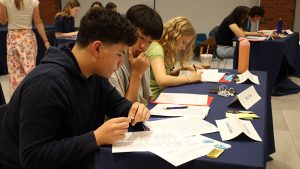
The new Civics & Economics in Action program is a one-week, immersive summer program for high school students who want to understand why government officials make the choices they do and how economics provides the framework to understand political decisions.
TFAS hosted two pilot programs for this new curriculum this summer, one at the University of Pennsylvania and another at American University.
At this program, students don’t merely memorize government structures, they learn how to think using the “economic way of thinking.” They examine the incentives, trade-offs and unintended consequences of the decisions behind public policy, from the Founding Fathers’ writing of the Constitution to current Supreme Court cases. Through hands-on lessons, leadership training and real-world case studies, students leave the program with a powerful framework for understanding a democratic republic and their role in shaping it.
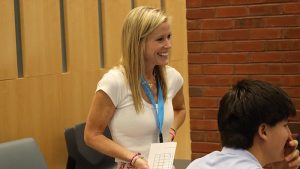
Amanda Stiglbauer, economics instructor and the FTE Economic Education Curriculum Fellow, said the program helps students see the economic thinking embedded in the nation’s founding.
“What we really wanted to do is create a program that wasn’t just a traditional civics program, and also wasn’t a traditional economics program, but really focused on how the founders had economic institutions in mind as they created our founding documents and how we celebrate that as a profound institution that has been established and continued to thrive over the course of 250 years,” Stiglbauer said.
The Intersection of Civics and Economics
The Civics & Economics in Action program focuses on the role economics plays in government, using the economic way of thinking and applying it to government behavior. The lessons outline the incentives that cause politicians to react in predictable ways, as shown in the marketplace. Real-world applications, such as ongoing Supreme Court cases, illustrate these lessons directly. Each morning builds upon the day before, providing students with the foundations of economics and civics to understand the complexity of government policy.
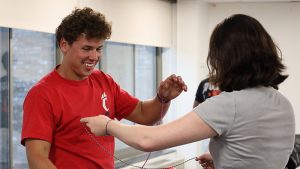
Interactive activities allow students to demonstrate their understanding of the marketplace in government. Students engage in activities simulating the American political landscape. They act as different districts, where they represent their constituents while negotiating with others. In doing so, students see firsthand the incentives legislators face—reelection and loyalty—and must determine the trade-offs they are willing to make.
Scarlett Krzeminska, a high school student from New Jersey explained how the program helped her understand economics.
“I’ve never studied anything relating to economics in my life, but I’m really interested in civics and politics, and I think FTE is doing a great job at introducing me to economics and really helping me understand the depth of it,” Krzeminska said. “I really thought we were going to be talking about policies or law in general, but it’s really cool to see the structure of the government, how it works and why people will make certain decisions.”
Leadership In Action
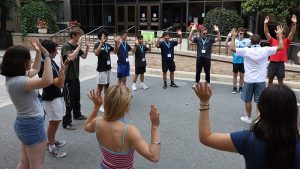
Over the course of a week, students also strengthen their leadership capabilities following the theme of a “Hero’s Journey.” Students work through personal growth and work to understand the experiences they have, values they hold and the behaviors they carry with them. From there, students learn how to actively communicate with others in a group and be an advocate in one’s community.
Activities focused on various methods of communication, emphasizing the role of clear and concise messaging. Participants learned firsthand how messages can get lost in translation, especially when working in a group, and how difficult it is to maintain clear communication. These exercises simulated organizational structures students may encounter in academic and professional settings.
Alyssa Ahmad, a high school student from Sacramento, California, highlighted how she’ll carry both the activities and lessons learned from the program with her in the future.
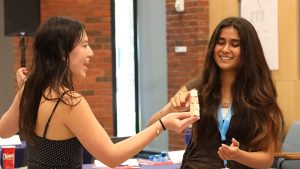
“One of the greatest things about FTE is that they try to show you different perspectives,” Ahmad said. “Not just academically, but also with characteristics: how you think of yourself, how you think of other people and how you think of your future too. I think that’s what’s so great, is that it’s building you up now and building you up for the future.”
Sessions also empowered students to better understand themselves and how to navigate through leadership decision making in times of uncertainty. Students wrestled with inquisitive discussions on how to surround themselves with people, how to communicate effectively, how to work with teams to navigate and prevent complex situations and the importance of messaging structure.
The Lasting Impact of Understanding Economics
From the beginning of the program to the end, students grew their understanding of how economic forces are embedded in government and are utilized every day. They left with a deeper knowledge of the marketplace and an understanding of how incentives and economic concepts are deeply entrenched in civics.
Allie Kauffman, a high school student from Charleston, South Carolina, shared how she’s using the skills she learned at the program in her daily life.
“It’s been such an amazing experience to get to learn more about how I used to put economics and civics in the classrooms, but now I’m actually able to put it into my life,” Kauffman said. “I can go home and know that I’ll be able to communicate strongly about civics, I can stand up for what I believe in and I have more beliefs in what I didn’t know before I came here.”
For more than half a century, TFAS has empowered students and educators nationwide, shaping young leaders and classrooms alike. With nearly 32,000 alumni of high school and teacher programs, TFAS is building a nationwide network of students and educators prepared to advance economic understanding and responsible leadership.
Generous donor support makes this lasting impact possible, equipping participants to carry these lessons into classrooms, campuses, careers and communities nationwide.
Make a gift today at TFAS.org/support to prepare the next generation of thoughtful, principled leaders.