
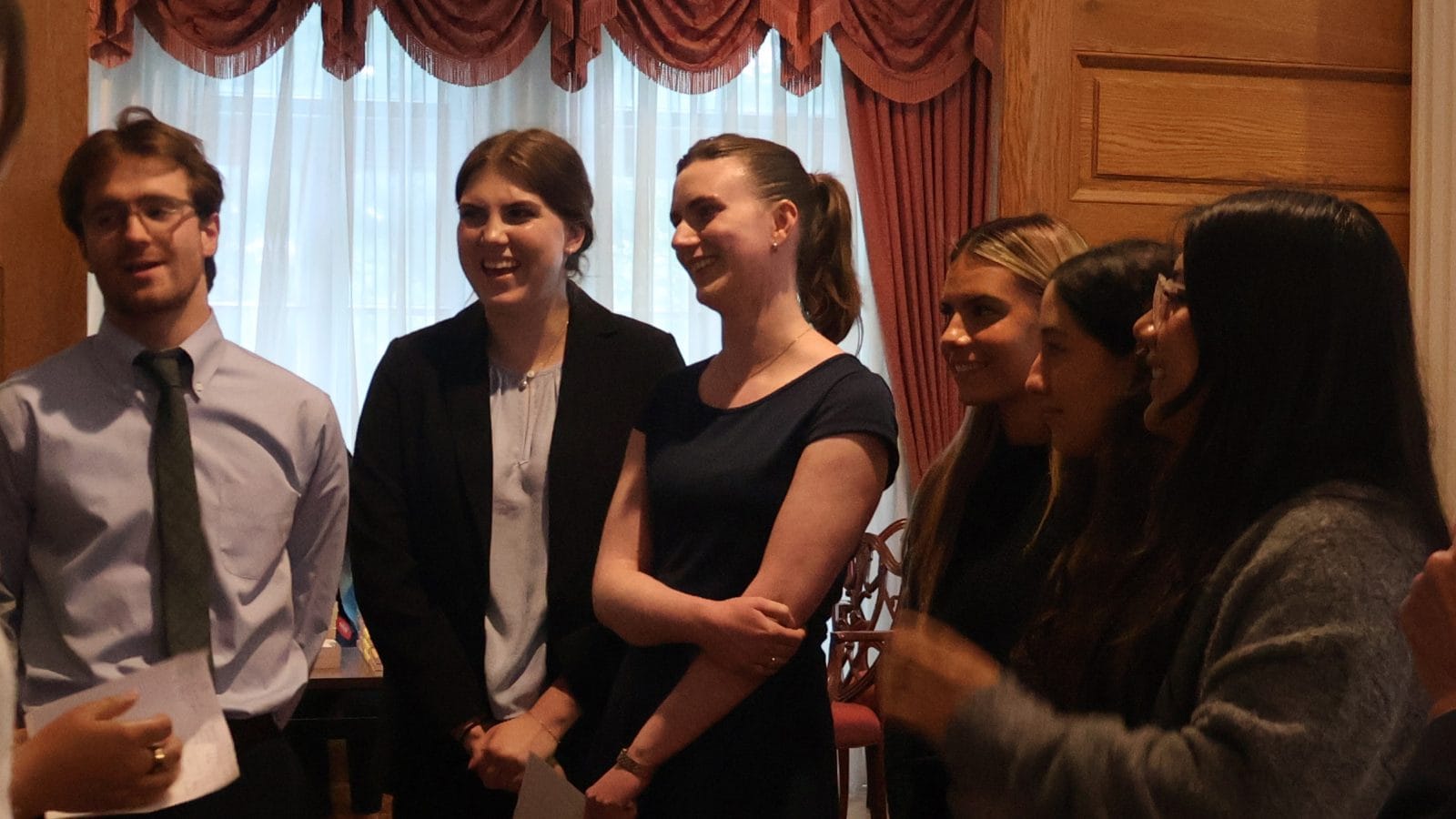
The Fund for American Studies (TFAS) hosted its second Honors Civics Leadership Seminar, an interactive educational program for TFAS students to explore economic freedom through the lens of the American Founding.

Through expert-led discussions, students interacted with hands-on civic exercises to bring constitutional principles to life. By connecting constitutional theory to modern practice, the seminar served as a dynamic bridge to the students’ coursework, offering a thorough examination of the free enterprise system and the economic way of thinking.
Connor Riley ’26, a student from Arizona State University, shared how the seminar helped him explore the nation’s founding principles.
“I participated in the Honors Seminar on Civic Leadership with The Fund for American Studies where we heard from several amazing speakers,” Riley said. “We spent the day discussing the Declaration of Independence, the role of the federal government and what the Constitution means in modern America. I learned a lot from the lively discussion on these critical documents.”
We spent the day discussing the Declaration of Independence, the role of the federal government and what the Constitution means in modern America. I learned a lot from the lively discussion on these critical documents.” – Connor Riley ’26, Arizona State University
In honor of America’s upcoming 250th, the exclusive full-day discussion focused on a central question: What does it mean to be a citizen of a free republic?
A Deep Dive into the Declaration of Independence
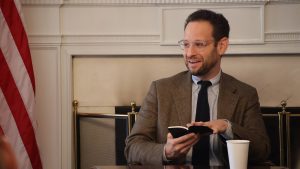
Fellows began the seminar with former TFAS Professor Dr. Sam Goldman, associate professor of humanities at the Hamilton School, University of Florida. They read through the Declaration of Independence, line by line, to understand the intricate meaning within the text itself. Goldman asked students how the meaning would change if any word was left out, emphasizing that each word was meticulously chosen for a significant reason.
He also highlighted the specificity in the Founders’ phrasing to portray an intentional meaning.
“Equality does not mean that all the units here are the same, but that they are equal in the fundamental respect,” said Goldman. “Rich or poor, big or small, they are all equally capable of governing themselves.”
Exploring The Roots of American Constitutional Greatness
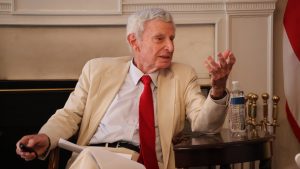
With a deeper understanding of the intentionality of one of America’s founding documents, students continued to trace American history from the beginning of mankind to the 21st century.
Dr. Donald Devine, TFAS Senior Scholar, followed the historical evolution of society, from the ancient system of hunting and gathering to modern-day democracy. Students discussed the foundations of democracy as a natural progression in the equality of all men.
Following the session, Devine signed copies of his latest release, “Thinking About Freedom and Tradition: Understanding the Philosophers Who Make the Case for Western Civilization,” continuing the conversation on the foundation of democracy in America after the seminar.
Economics at the Time of the Founding

Dr. Anne Bradley, TFAS vice president of academic affairs, joined the students to provide a brief background on Adam Smith and his influence on the Founding. She underscored his developmental and empirical perspective on economics as essential to his understanding of wealth accumulation based on people’s choices and responses to incentives.
While the Founders were not in direct communication with Smith, they shared a fundamental intellectual history. Students examined the texts for the similarities in ideas and language that deeply influenced the formation of the United States.
“If you look at the language of the Declaration, the Founders understood that what government promises you is very limited,” Bradley said. “The pursuit of happiness is not a guarantee of happiness; it’s the liberty to pursue that happiness.”
Using the economic way of thinking, students also discussed the potential outcomes of negative and positive rights, determining what both would look like in practice from the government. The cohort ended the session with the lasting question: What is the right mechanism to direct our resources in the U.S.?
Four Corners: An Interactive Civics Activity

Students concluded the seminar with an interactive activity to demonstrate their understanding of the economic way of thinking in government. Tom Rooney, former Illinois State Senator and mentor teacher for TFAS’s high school program division, the Foundation for Teaching Economics led the session on the separation of powers between the executive and legislative branches.
During the executive power simulation, titled “Should the President Act Alone?,” the students had to decide how issues and policies should be handled and enacted through acting out two scenarios. They weighed the marginal benefits and costs of each scenario before choosing one of four groups that would determine the speed and process of legislation: executive power, congressional power, both or neither.
Throughout the activity, students provided thoughtful, in-depth answers for each scenario and group, addressing essential questions and issues that weighed the costs and benefits of the options. This simulation is also part of the program for the new Civics & Economics in Action program for high school students.
Reflecting on Civics
Billie van Leeuwen ’26 of Leiden University explained that the seminar helped her to engage in impactful conversations during her summer in the nation’s capitol.
“It was interesting to discuss topics like the Declaration of Independence, the role of a free market economy and some of the challenges the United States is facing today,” Leeuwen said. “These conversations gave me a deeper understanding of the ideas that continue to shape American society and politics. I’m grateful for opportunities like these to learn from experienced scholars and engage in meaningful discussions during my internship in the U.S.”
These conversations gave me a deeper understanding of the ideas that continue to shape American society and politics. I’m grateful for opportunities like these to learn from experienced scholars and engage in meaningful discussions during my internship in the U.S.” – Billie van Leeuwen ’26, Leiden University
Students left the seminar with a deeper understanding of the American founding and the importance of the founding documents. By applying the economic way of thinking, the group was able to answer the question of what it means to be a citizen of a free republic and why it is necessary to continue America’s experiment in liberty 250 years later.
To learn more about the incredible array of TFAS’s Teaching Freedom 250 programming, visit TeachingFreedom250.org.