

Over the past nine months, 19 young professionals working in the nation’s capital explored the philosophical underpinnings of American political life through the 2025-26 TFAS Woodhouse Public Policy Fellowship. Fellows debated pressing policy questions, connected with peers working in public policy and engaged in academic discussions and retreats to build a deeper understanding of American political thought and the principles of fusionism.

Maria Copeland ’25, Philanthropy Roundtable, shared how the program builds a community of young professionals to engage in and debate ideas in a free society.
“The fidelity to the spirit of conservative thought has been preserved in and through gatherings of people,” Copeland said. “What I will remember from my experience in TFAS is that the ideals we treasure have always been best upheld through rigorous debate in a committed community and I’m grateful for TFAS’s efforts to unite the young people of Washington toward this aim.”
These conversations and debates focused on the question, “What is conservatism?” Fellows traced the roots of the conservative movement through thinkers like F.A. Hayek, Russell Kirk, William F. Buckley and Frank Meyer, weighing the tension between freedom and virtue and the role of public policy.
Throughout monthly discussions, Fellows heard from lecturers Dr. Anne Bradley; Matthew Continetti, Novak ’08; Dr. Samuel Gregg; Stephanie Slade, Novak ’16; and Dr. Donald Devine on the history and evolution of the conservative movement.
A Fall Retreat to Michigan Exploring the Roots of Conservative Thought
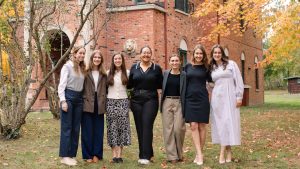
The cohort traveled to Mecosta, Michigan, for a fall retreat to the Russell Kirk Center for Cultural Renewal. Throughout the weekend, Fellows examined the beliefs, practices and institutions of America’s Judeo-Christian tradition.
Speakers explored the roots of conservative thought and American order, which serve as a foundation for the renewal of modern fusionism. David Corey, professor of political science at Baylor University, considered the discourse around topics such as order and freedom in the American tradition; the law and the prophets; the genius of Christianity; and Greek and Roman inheritances.
Brad Birzer, professor of history and Russell Amos Kirk Chair in American Studies at Hillsdale College, also led multiple discussions with Fellows. Conversations focused on the Constitution of church and state; the colonial order and the 18th-century Enlightenment; and Lincoln’s defense of the American order toward a new fusionism.
David McGarry ’25, Taxpayers Protection Alliance, expressed the value of the fall retreat and how it enhanced the discussions and readings during the nine-month fellowship.
“It is one thing to read Kirk; it is another to eat, talk and laugh in his family home,” McGarry said. “On our retreat, we were able to inhabit, if only for a few moments, other times and places significant to conservatism and into whose very structures, décor and environs conservative thought and mores are woven in a way that cannot easily be distilled into words.”
A Spring Retreat to Historic Philadelphia
In February, the Fellows visited historic Philadelphia, Pennsylvania, for a retreat exploring the roots and historic sites of the nation’s founding and recovering American ideas on liberty during the semiquincentennial.
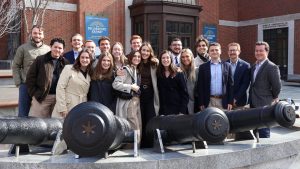
Alongside site visits and lectures, Fellows explored the founding period from the Magna Carta to the ratification of the Constitution through thoughtful discussion sessions. Gary Gregg, director of the McConnell Center at the University of Louisville, welcomed Fellows with a conversation about the influence of the play Cato on George Washington’s life.
Jeff Polet, director of the Ford Leadership Forum at the Gerald R. Ford Presidential Foundation, examined the nature of the American Revolution, from its conception to the modern day. Polet reflected on the programming, stating that it deepened the knowledge of and appreciation for a constitutional republic in young professionals.
“The TFAS Woodhouse Fellows Program does an excellent job of promoting two important goals: deepening the knowledge of and appreciation for our constitutional republic and helping young professionals in our nation’s capital reflect more deeply on their vocations,” Polet said. “The weekend seminars not only create a greater understanding of our political system but also build a supportive community that is essential for navigating the challenges of life in D.C.”
The TFAS Network’s Lasting Impact
As the Fellows completed the Woodhouse Fellowship, they reflected on the meaningful connections they developed alongside lasting friendships. They left with a deeper understanding of the conservative intellectual tradition and how it continues to shape public policy today.

Sasha Raikin ’25 of the Ethics and Public Policy Center, remarked on the endurance of the nation and the conservative tradition during America’s semiquincentennial.
“The United States is unique among the world’s countries not only in its republic and constitution, but also in its deep ability to survive disagreement on some of the most deeply divisive and important issues, whether on the choice to declare independence, to ratify the constitution, to end slavery or segregation,” Raikin said.
The Woodhouse Public Policy Fellowship would not be possible without the generous support of TFAS donors, particularly Marilyn Woodhouse, who endowed the fellowship, to provide young leaders working in public policy with a thoughtful network of peers and mentors who strengthen the next generation in conservative thought.
TFAS is now accepting applications for the next class of Woodhouse Public Policy Fellows. To learn more about the program and apply to the 2026-27 cohort, visit TFAS.org/PPF. The deadline to apply is July 8, 2026.